Download Ronin: The Last Samurai APK 2.19.764 Free for Android
Dreamotion Inc. APK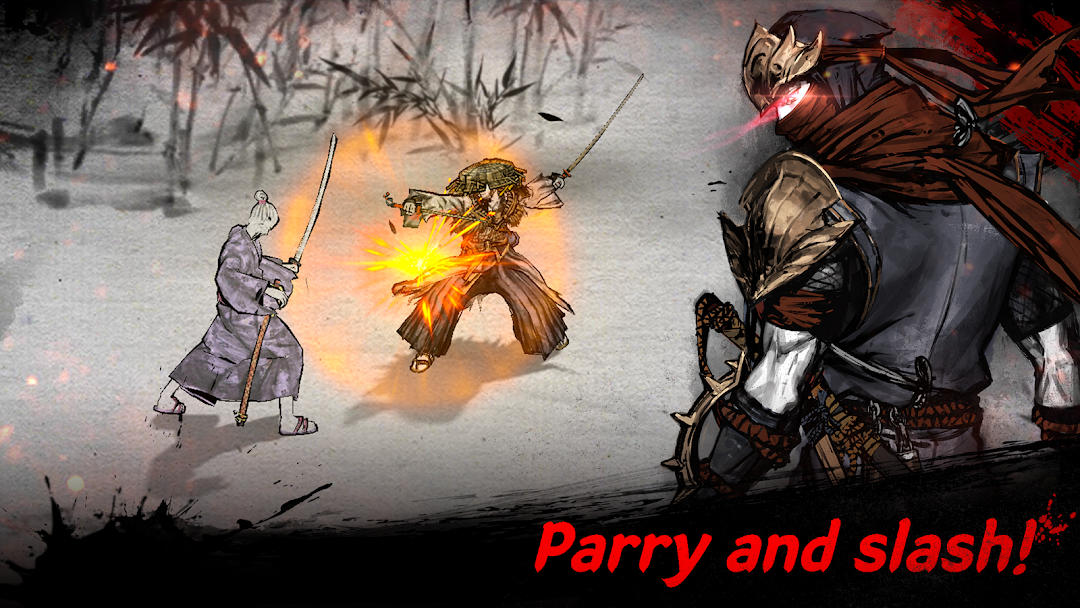

| Tên | Ronin: The Last Samurai |
|---|---|
| Nhà phát hành | Dreamotion Inc. |
| Phiên bản | 2.19.764 |
| Kích thước | 422MB |
| Yêu cầu | Android 6.0 |
| Google Play | Google Play ↗ |
| Danh mục | Role-Playing |
| Lượt tải | 6 |
| Giá | MIỄN PHÍ |
| Đánh giá |
★
★
★
★
★
0/5
(0)
|
| Tác giả | |
| Cập nhật |
Ronin: The Last Samurai has crossed 10 million Google Play installs since its 2020 launch, with 10 acts of 20-stage runs and a two-button parry system built around Sekiro-style posture damage.
Ronin: The Last Samurai is a roguelike action title from Korean studio Dreamotion Inc., available for Android and iOS, with version 2.19.760 released in June 2025 and the current build 2.19.764 pushed to Google Play afterwards. The game stages 1-versus-1 and 1-versus-many sword duels across 10 chapters of feudal Japan, each act running 20 stages with a mid-boss at stage 5, stage 15, and a full boss at stage 10 and stage 20. Combat runs on two controls, a left button that moves, blocks, and parries, and a right button that attacks and dashes, with success measured by reading the red-kanji heavy attack tells rather than mashing.
- Two-button parry combat and the posture damage system
- The 10-act roguelike chapter structure and the Onigiri energy economy
- The boss roster across acts and their distinct movesets
- Weapons, armor, pets, and the gray-to-red gear rarity ladder
- Playable Ronins and the Mastery progression
- Endgame content: Shura’s Road, Arena of Carnage, Yokai Battle, and Chaos Crevice
- Ink-wash visuals and the Japanese instrument soundtrack
- What’s new in version 2.19.764
- Ronin: The Last Samurai MOD APK features
- Frequently asked questions
Two-button parry combat and the posture damage system
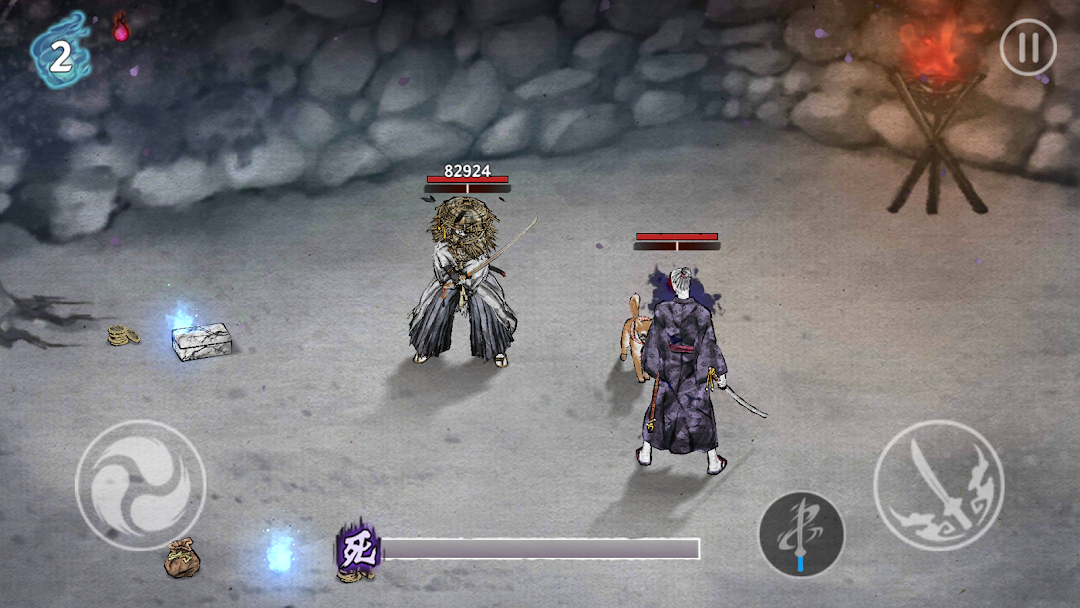
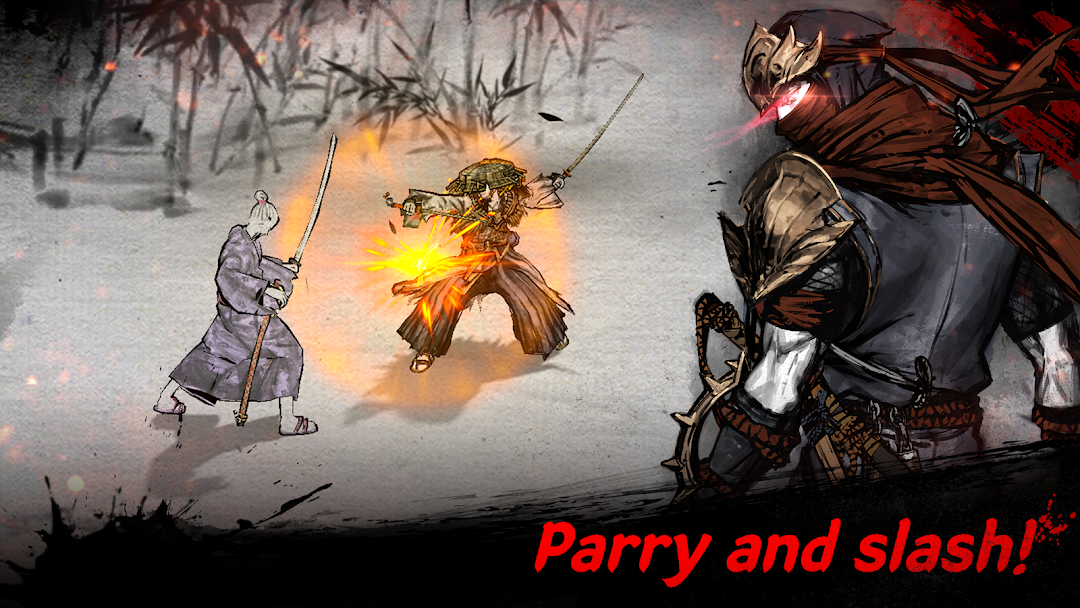
Combat in Ronin: The Last Samurai resolves through two pressure systems running side by side. The red bar above an enemy is Attack damage HP, the standard pool that drops as sword cuts land. Below it sits the yellow Posture bar, a balance gauge that fills with every successful block or parry. When Posture breaks, the enemy is stunned for a window of roughly 2 to 3 seconds, opening a free critical strike that bypasses HP. The same rule applies to the player, which is why Wolves (jump-attacking weeds with low Posture stats) crumble after one parry while Shogun’s Soldiers (Spear) take several reads before their bar caps out.
Inputs break down into a small set of intentional moves rather than a button-mashing combo tree:
- Light parry (tap left): a quick tap of the left button just before a white-flash attack lands deflects the strike, deals Posture damage, and opens a 1-second window to chain right-button slashes.
- Heavy counter (tap right at the red kanji): when a red 危 symbol appears above the enemy’s head, striking right at the wind-up frame replaces a normal swing with a Counter Flash, dealing 3 to 5x normal damage and refilling part of the Skill gauge.
- Hold-attack charged strike: a recent patch added a guaranteed critical by holding the right button, useful against the Act 4 mid-boss Nodachi captain who crouches to heal at 2/3 HP.
- Dash attack: walking toward a distant Shogun’s Soldier (Jogun) musketeer then tapping right closes the gap in a single dash, which is the only reliable way to interrupt a rifle reload.
- Block cancel: pressing left during any animation cancels the recovery frames, the move that speedrunners use to chain attacks back into parries.
The game rewards deliberate spacing over aggression. A tap-too-fast input on a Cascading Naginata leaves the swordsman locked in a slow recovery, often clipped by a Raven Ninja’s dual-dagger follow-up. The same Naginata, paced correctly, reaches across two enemies at once during the 4-versus-1 ambush at Chapter 2 stage 11.
The 10-act roguelike chapter structure and the Onigiri energy economy
Every campaign run in Ronin: The Last Samurai shares the same skeleton. You enter a chapter, fight 20 stages back to back, lose all stage progress on death (loot earned does carry over), and keep going until you clear the act boss. The current build runs from Chapter 1 (Burning Village) through Chapter 10 (Shogun’s Citadel), with Chapter 9 and Chapter 10 added in a content update alongside two new equipment slots, Fan and Belt.
Energy works on the Onigiri rice-ball currency, not stamina:
- Cost per run: 5 Onigiri opens one chapter attempt, win or lose.
- Cap: 25 Onigiri at base, raised to 50 with the Guild Operation License timed pass.
- Recharge: 1 Onigiri every 12 minutes, so a fully drained pool refills in 5 hours of real time.
- Ad refills: up to 5 rewarded ads per day, granting 5 Onigiri each; once the cap of 5 ads is hit, the cooldown locks for roughly 6.5 hours.
- Account-level refill: a full bar refunds every time the player level ticks up, which happens twice or three times per hour during Chapters 1 to 3.
- Gem purchase: 50 Gems buys 10 Onigiri, the slowest gem sink in the game and the worst trade pre-Chapter 5.
Inside a run, two safety nets matter. Reincarnation Scrolls let you resurrect once per run mid-stage, best saved for the final stretch before an unclear boss. Spirit of Vengeance drops from every first-time boss kill and goes straight into the Mastery tree, which is the reason veterans keep Reincarnation Scrolls in reserve specifically for boss attempts (a wasted scroll on stage 14 against Shogun’s Soldiers is a missed permanent stat point).
The boss roster across acts and their distinct movesets
Bosses in Ronin: The Last Samurai are not stat checks. Each fight rotates through a fixed 4 to 6 move pattern, and unlike Wolves or Standard Shogun’s Soldiers, boss heavy attacks deal full damage even after a botched parry. The 10-act roster covers spear specialists, gunslinger duels, ninja swarms, and a poison-laced forest fight.
The most-discussed boss fights, in order of act:
- Act 1 Boss (Cross Spear): the Ashina seven-piece spear motif. Returns as the final boss of Act 7. Heavy attack is a downward thrust; punish window opens for 1.2 seconds after the spear sticks into the ground.
- Act 2 Mid-boss (Chain Mace + Bow): ninja hunter pattern, alternates flail swings at close range with two arrows fired at mid-range. Comes back as the 5th boss of Act 7 and the 1st boss of Act 10.
- Act 2 Boss (Red Ghost): kicks then body-slams. The only act 2 fight that punishes greedy combos, since the body-slam triggers if the player is mid-swing within 2 squares.
- Act 3 Mid-boss (Contaminated Forest): a poison-damage heavy attack that yellows the screen for 4 seconds, after which the Posture bar drains on its own.
- Act 4 Mid-boss (Nodachi Captain): wields a huge Nodachi, crouches to recover HP when reduced to 2/3, which means any kill attempt under 2/3 has to chain into a Counter Flash to outpace the heal tick.
- Act 4 Boss (Snake Eye): dual pistols, with a flame attack layered on once Stamina drops to roughly 50%. Heavy attack timing is the hardest read in the first half of the game.
- Act 5 Mid-boss (Crow Ninja): one-handed katana, X-slash heavy attack, vanishes at half HP and summons two Raven Ninjas as adds.
- Act 6 Boss (Apostate Monk): drinks yellow liquid that triggers a confusion debuff on a hit, then adds a fire-spit heavy attack at half HP and a self-heal sip at 1/3 HP.
- Act 8 Boss: opens with tonfa, swaps to nodachi roughly 40% through the fight, teleports between attacks. White hair and red eyes mark the boss as the same race as final Shogun Tsunamitsu.
Killing each first-time boss drops a Spirit of Vengeance, the only way to permanently raise Ronin stats outside of equipment level-ups. The Mastery board converts these into HP, attack, and Posture nodes, with the boss kill itself worth more long-term than the gold and gear dropped on the same stage.
Weapons, armor, pets, and the gray-to-red gear rarity ladder
Gear in Ronin: The Last Samurai sits on a six-tier rarity ladder, from Gray (Common) through Green, Blue, Epic (Purple), Legendary (Gold), to the top-end Red Mythic that only drops in late Shura’s Road runs. Tier changes the base stats and the upgrade cap, with a Red Mythic katana reaching roughly 4 to 5x the damage of a fully-upgraded Gray equivalent of the same weapon family.
The equipment families and named pieces players hunt for:
- Weapons: Katana (balanced, three-hit basic combo), Spear (long reach, slow swing), Naginata (sweep arc, hits two squares wide), Tonfa (fast, low single-hit damage), and Bow (only weapon with a ranged auto-attack). The Cascading Naginata and BlazeLight Bow are the two signature unlocks that arrive with the second playable Ronin.
- Armor sets: Ninja Suit (low HP, high Posture stat), Samurai Armor (balanced HP and defense), and the Fox Deity Armor (top-tier Legendary, paired with Tomoe Gozen on unlock).
- Accessory slots: the base game offers a Pendant and Ring, with Fan and Belt slots added in the Chapter 9 and Chapter 10 content patch.
- Pets: the default Dog (passive HP regen during runs), the Panda (added in the Shura’s Road patch, +Attack buff), and the Shiba Inu (added with the Chaos Crevice patch, deals chip damage to adds).
Two systems sit on top of the rarity ladder. Combining 5 identical-rarity items merges them into one item at the next rarity, which is the only way to push gear past Epic since drops cap at Legendary in Chapters 1 to 6. Dismantling old gear refunds material based on its level, so a Green sword upgraded to level 20 returns roughly 80% of the resource cost when traded for a fresh Blue. Limit Break, added in the same patch as Fan and Belt, raises the upgrade ceiling on Legendary and Red Mythic pieces by 5 levels per Break, fed by Spirit Shards farmed only in Shura’s Road.
Playable Ronins and the Mastery progression
Ronin: The Last Samurai launched with a single character, Kenji, the default male samurai. Tomoe Gozen, a historical female warrior reworked as a playable Ronin, was added later as a 3,000-Gem unlock and arrives with a pre-set Cascading Naginata, BlazeLight Bow, and Fox Deity Armor, with all Mastery points unassigned. Switching to Tomoe is effectively a Chapter 1 restart for the Mastery tree, so the build choice has weight.
Mastery is the permanent progression spine. Every first-time boss kill yields one Spirit of Vengeance, spendable in the Mastery board on three branches:
- Body branch: flat HP and Posture caps, the safer choice for new Tomoe runs in Chapter 6 or later.
- Sword branch: direct Attack damage and Counter Flash damage multipliers, the choice if Snake Eye and the Act 6 Apostate Monk read poorly for the player.
- Spirit branch: Skill gauge fill rate and Reincarnation Scroll efficiency, useful for Shura’s Road grinds where the death cost is highest.
Skills, unlike Masteries, are tied to the weapon equipped. A Katana grants a different ougi (special move) than a Naginata, so a Mastery build sunk into Sword branch keeps its value across weapon swaps while a Skill-specific build resets every time a new weapon family is picked up. The Limit Break system, layered on top, only triggers when both gear and Mastery hit a checkpoint, which is why some Chapter 8 runs gate on Mastery rather than on gear drop luck.
Endgame content: Shura’s Road, Arena of Carnage, Yokai Battle, and Chaos Crevice
Story chapters end at Chapter 10, but the post-story content is where active players spend the most time. Four modes layer on top of the main campaign, each unlocking at a different milestone.
Shura’s Road is the hard mode of the campaign, reusing the same maps with stat-inflated enemies and a tighter Onigiri economy (every stage carries an extra death penalty). Shura’s Road Chapter 1 unlocks after clearing Chapter 7 of the main story, and it is the only mode that drops Red Mythic-tier shards. Arena of Carnage is the PvP mode, 1-versus-1 against another player’s ghosted Ronin loadout, with the matchmaking unlocking after Chapter 7. Season Ranking inside Arena of Carnage resets every 14 days, with the top tier paying out exclusive skin tokens.
Yokai Battle is a recurring event mode added with the same patch that introduced Tomoe Gozen. Each Yokai run is a single 5-stage gauntlet against folklore creatures (the Tengu mid-boss is the most common stop), and the reward track pays Essence, a currency used to forge accessory-slot gear. Chaos Crevice, introduced alongside the Shiba Inu pet, is a procedurally seeded dungeon with stage layouts that swap on every entry, designed for short 10-minute runs after Onigiri caps refill. Daily Mission, Chronicle of Battle, and the Wandering Merchant rotating shop sit around these modes, and the Path of the Warrior battlepass cycles every season for cosmetic, gear, and Gem rewards.
Ink-wash visuals and the Japanese instrument soundtrack
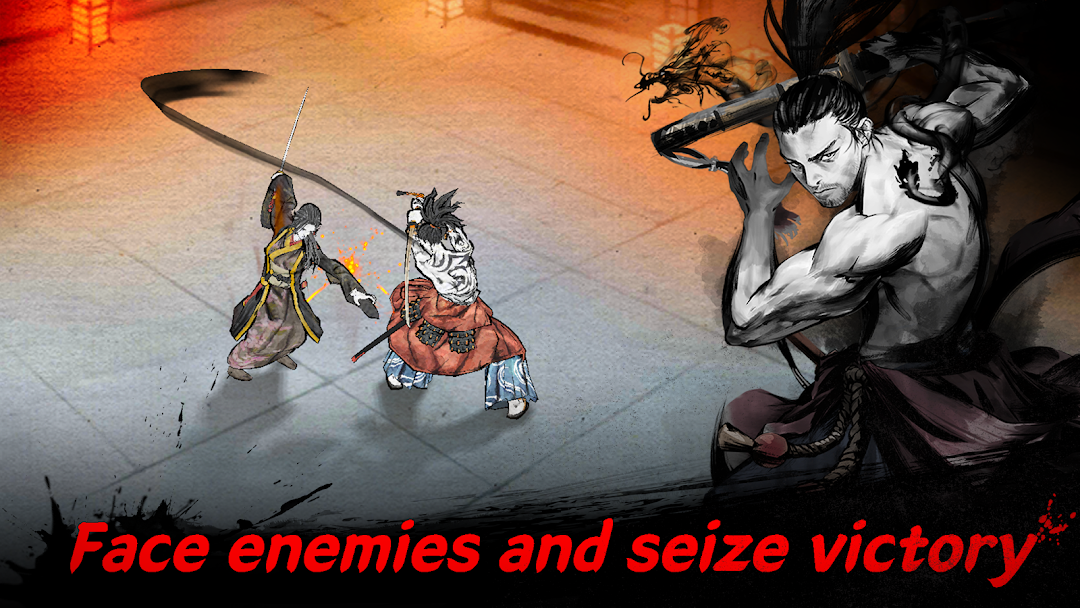
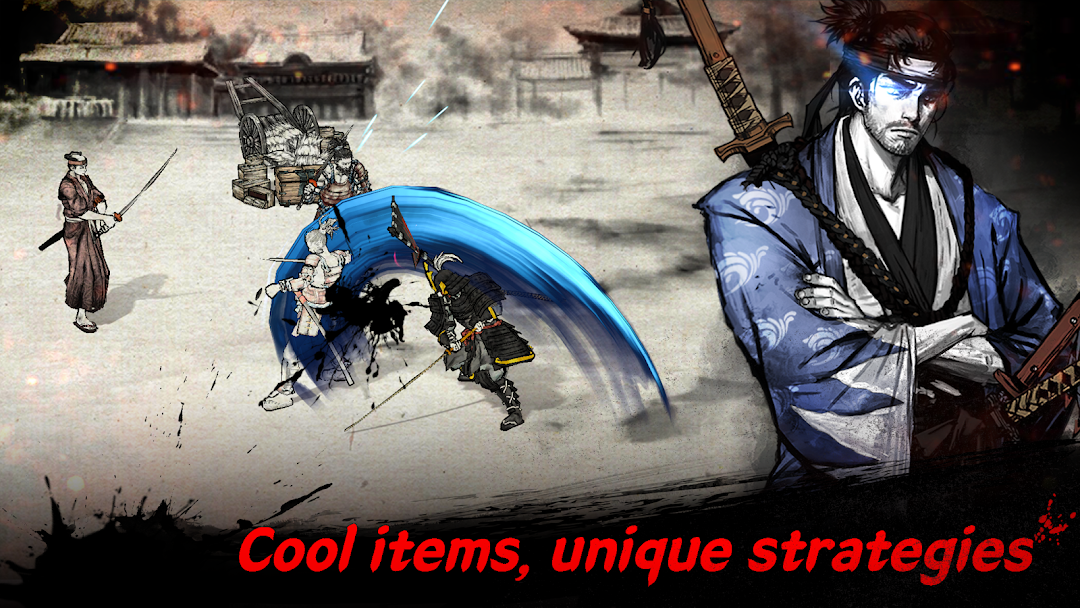
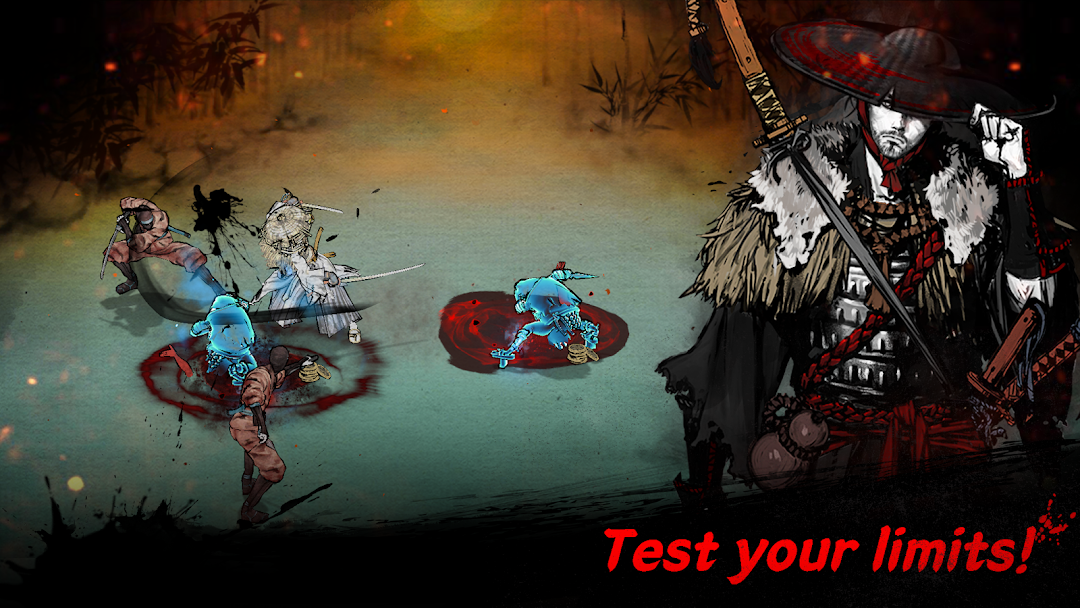
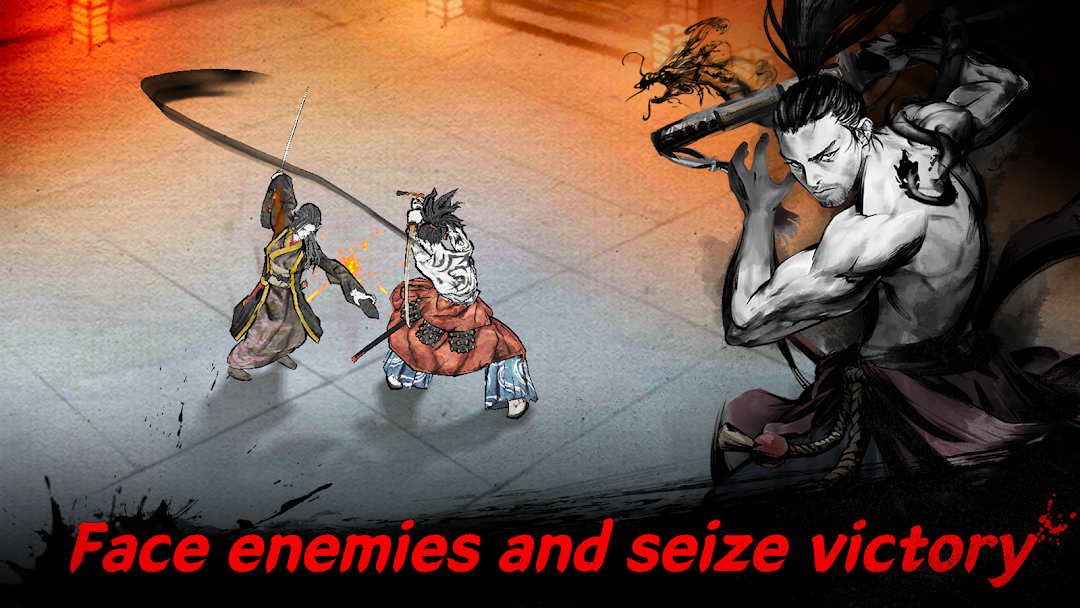
The art direction in Ronin: The Last Samurai is the single most-cited reason players first download the game. Every frame is rendered in suiboku-ga, the traditional Japanese ink-wash painting style, with sparse black-and-grey environments broken up by red blood splatter on kills and gold accents on Legendary gear glow. Each katana slash leaves a brush-stroke trail that fades after roughly 0.5 seconds, and finishing strikes paint a sumi-e splash that briefly overtakes the screen.
The 11 levels across feudal Japan rotate through specific painted backdrops, including the Burning Village in Chapter 1, the Contaminated Forest in Chapter 3, the Floating Lantern Bridge in Chapter 5, and the Shogun’s Citadel in Chapter 10. Character skins, purchasable for 7-day or 14-day windows, swap the Ronin’s outer kimono and armor while keeping the ink-stroke animations consistent. The soundtrack is built on Taiko drums and a Japanese flute (shinobue), with low-tempo shamisen lines bleeding in during boss intros. Compared to mainstream samurai games on PS5 or Switch, on-screen blood is dialed back to ink-spray rather than realistic gore, which is one reason the game survived YouTube and TikTok content guidelines through 2024 to 2026.
What’s new in version 2.19.764
Version 2.19.764 is the most recent build of Ronin: The Last Samurai on Google Play, released after the prior 2.19.760 patch from June 2025. The current build sits at 421.6 MB on Android 6.0 and above. The changelog from the official Dreamotion Facebook page lists the following changes from the recent run of patches.
- Chapter 9 and Chapter 10 added. Two new story acts close the main campaign, with the final boss confirmed as Shogun Tsunamitsu Saigo. Both chapters reuse the 20-stage structure with mid-bosses at stage 5, 15 and full bosses at stage 10, 20.
- Limit Break system introduced. Legendary and Red Mythic gear can now break past their previous upgrade cap by 5 levels per Limit Break, fed by Spirit Shards farmed in Shura’s Road.
- Fan and Belt equipment slots added. Two new accessory slots open up, raising the total equipped piece count and giving room for Posture-focused builds.
- Shura’s Road Hard Mode update. Stat scaling on Shura’s Road enemies was rebalanced, and the Red Mythic shard drop rate was raised on Chapter 6 and later Shura runs.
- New Pet: Panda and Shiba Inu added. Two pets joined the roster alongside the default Dog, with the Panda granting an Attack buff and the Shiba Inu landing chip damage on adds.
- Season Ranking system rebalance. The 14-day Arena of Carnage ranking now resets cleanly without partial-progress carryover, and tier rewards shifted to cosmetic-first.
- Chaos Crevice introduced. A procedurally seeded short-run mode, around 10 minutes per attempt, intended as a between-Onigiri-refill loop.
- NPC Manekineko added. A new shop NPC selling rotating gear bundles and Essence in exchange for Daily Mission tokens.
- Bug fixes and stability. The patch notes for 2.19.764 call out a list of crash fixes on Android 12 and Android 13 devices plus minor balance tweaks to the Apostate Monk fire-spit timing.
Ronin: The Last Samurai MOD APK features
This MOD is built for players who want to clear Shura’s Road and the Chaos Crevice without grinding 25-Onigiri refills, and for players who would rather try Tomoe Gozen’s Cascading Naginata kit without sinking 3,000 Gems on the unlock. The modifications strip out the timed energy gate, the gem-locked roster, and the rewarded-ad refill loop, while keeping the core parry combat unchanged.
Mod Menu with toggleable cheats
The MOD APK loads a floating in-game menu (top-left corner of the chapter screen) with switches for each cheat, so cheats can be turned off during Arena of Carnage runs and turned back on for Chaos Crevice farms. The menu includes God Mode, High Damage, Freeze Enemy, and an instant-Skill-gauge toggle. The instant-Skill-gauge switch is the most useful for Tomoe Gozen players, since her Cascading Naginata ougi otherwise requires three Counter Flashes to charge.
Unlimited Gems and Gold
Gem and Gold counters stay capped at 9,999,999 instead of starting fresh at 0 Gems and roughly 500 Gold. That lets you buy the 3,000-Gem Tomoe Gozen unlock plus the Fox Deity Armor cosmetic skin on day one, skip the 50-Gem-for-10-Onigiri energy buy as a sunk-cost trade, and pull repeated 10-pulls on the gear gacha for Legendary-tier Cascading Naginata without spending real money on the 5,500-Gem starter pack.
High Damage and One-Hit Kill
Attack damage is multiplied so that even a Gray-tier katana drops the Act 4 Snake Eye boss in one Counter Flash, where the stock build needs a Blue-tier or higher Snake-Eye-killer loadout and a near-perfect read on the dual-pistol heavy attack. The same multiplier lets a single tap clear the 20-stage Chapter 10 run in under 4 minutes, useful for Spirit of Vengeance farming on the Tsunamitsu Saigo final boss.
Freeze Enemy and Weak Enemy
This toggle pauses enemy attack patterns, so the Act 4 Nodachi Captain stops crouching to heal at 2/3 HP and the Act 6 Apostate Monk never reaches the fire-spit heavy attack. Wolves, Raven Ninjas, and Shogun’s Soldier (Artillery) cannon volleys all stand idle during the toggle window. The frozen-enemy effect is the cleanest way to grind Mastery points off Shura’s Road bosses without burning Reincarnation Scrolls.
No Ads and unlimited Onigiri refills
The rewarded-ad gate on Onigiri refills is removed, so you no longer cap out at 5 ad watches per day and 5 Onigiri per ad. Reincarnation Scroll free-continue popups also auto-grant without playing the 30-second ad. The Onigiri counter itself is unlocked past the 25 cap, removing the 12-minute-per-Onigiri recharge wait entirely.
Save Editor
The MOD APK ships with a save-edit tool that exposes Mastery node values, equipment level, and Spirit of Vengeance count. The Limit Break system, which normally requires Spirit Shards farmed only in Shura’s Road, can be raised directly through the save editor on any Legendary or Red Mythic piece.
| Criteria | Stock APK | MOD APK |
|---|---|---|
| Onigiri energy cap | 25 (50 with paid Guild License) | Unlimited, no 12-minute recharge |
| Gems | Earned from boss kills or 5,500-Gem starter pack | Locked at 9,999,999 |
| Gold | Stage drop, dismantling refund | Locked at 9,999,999 |
| Tomoe Gozen unlock | 3,000 Gems | Free on first launch |
| Reincarnation Scroll | 1 per run, 30-second ad for free continue | Unlimited, no ad |
| Boss heavy attacks (Apostate Monk fire, Snake Eye flame) | Full damage on a missed parry | Frozen with toggle on |
| Limit Break Spirit Shards | Farmed in Shura’s Road only | Editable through save editor |
| Rewarded ads | 5 per day cap, 6.5-hour cooldown after | Removed across the menu |
Frequently asked questions
Is the Ronin: The Last Samurai MOD APK safe to install on Android?
The MOD APK is signature-verified and scanned on VirusTotal before publishing, with the same 421.6 MB package size as the Google Play build. Android 6.0 or higher is required, and at least 500 MB of free storage on top of the package is recommended for cache and patch updates. If the prior MOD build is still installed, the new APK installs over it without wiping local save data.
Will the MOD get my Dreamotion account banned or block code redemption?
The MOD APK runs as a separate local install and does not sync to a Google or Facebook login, which is why MOD progress does not carry into the Google Play version. Promo codes shared through the official Dreamotion Discord (gold drops, 4-star gear box tickets) can still be redeemed through the Settings menu, but rewards apply only to the modded save. Online features like Arena of Carnage Season Ranking are not recommended on the MOD build.
How is the MOD different from the stock APK in actual play?
The stock APK keeps the 5-Onigiri-per-run cost, the 3,000-Gem Tomoe Gozen gate, and the 5-ads-per-day Onigiri refill cap. The MOD removes all three, plus it locks Gems and Gold at 9,999,999 and exposes Mastery and Limit Break values through a save editor. Core parry combat, boss movesets, and the ink-wash visual style are unchanged so that Act 6 Apostate Monk fights still resolve through Posture damage timing.
What Android version does Ronin: The Last Samurai need to run smoothly?
Android 6.0 (Marshmallow) is the floor, released around September 2015. The current build is roughly 421.6 MB, with an extra 100 to 500 MB recommended for cache and patch updates. Devices with 3 GB or 4 GB of RAM (such as Redmi Note 7S-class hardware) run the game without frame drops on Chapters 1 to 6, while Shura’s Road and Chaos Crevice runs prefer 6 GB of RAM and Android 11 or higher for the smoothest parry-frame timing.